


Pfizer
Changing physicians' beliefs with voices they already trusted.

The insight
Emergency physicians didn't believe their sickle cell patients. Changing that meant borrowing voices they already trusted.
Employment: Eveo, a healthcare communication agency (acquired by Capgemini Invent). Deliverables: SCDTruths educational platform · video series · clinical print ads · point-of-care materials · medical congress exhibit.

Challenge
The audience is the obstacle
In pharma and healthcare creative, the obstacle is usually the review process. On this campaign it wasn't. Patients with sickle cell disease (SCD) suffer vaso-occlusive crises (VOCs), painful events that frequently send them to the emergency department. Emergency physicians, working from limited knowledge of SCD, often read a patient's urgent request for opioid pain relief as drug-seeking. Treatment gets delayed or under-dosed, and patient outcomes suffer.
Two beliefs did the damage: that VOC pain isn't as severe as patients report, and that opioid addiction is widespread in these patients. Both are wrong, and neither was going to be corrected by a pharmaceutical company with a product to sell.


Solution
The credibility had to come from somewhere else.
The experts weren't asked to correct the record. They were asked to describe how their own perceptions of sickle cell patients had changed over time. A skeptical physician watching that isn't being told they're wrong. They're watching a peer who already reconsidered.
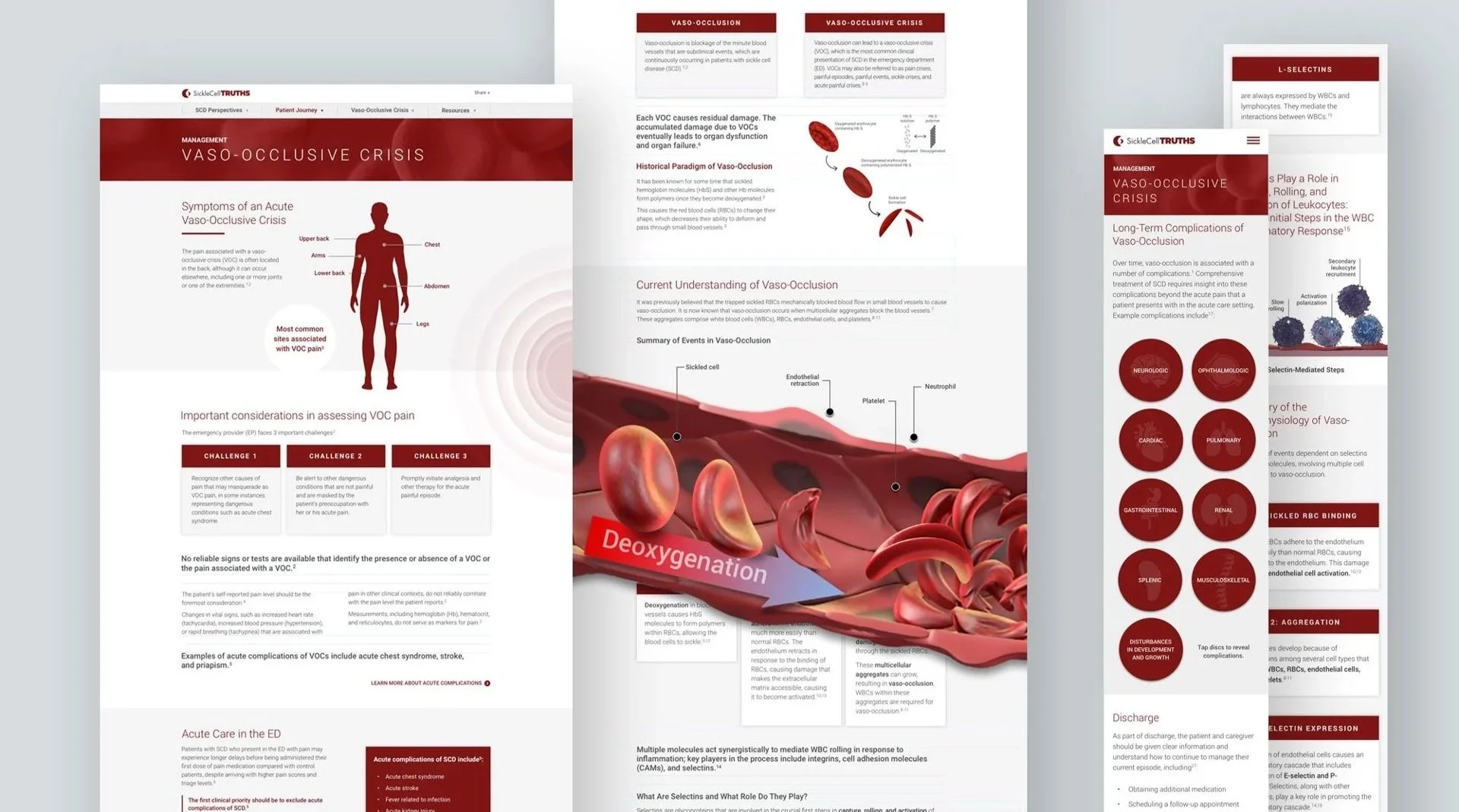
We recruited rare SCD specialists, emergency medicine opinion leaders, and patient advocacy voices, and built the unbranded SCDTruths video series and educational platform around them, carried into clinical print and a medical congress exhibit.
The work was built to expect Medical, Legal and Regulatory review: graphics traceable to source, formats that survive edits, and a hierarchy with enough give that a reviewer's addition wouldn't collapse the site.

Result
Outcome
Focus group testing showed that 95% of emergency department health care providers reported changed beliefs about sickle cell patients after peer-to-peer education.
Clinical trial results ended the program before launch. Pfizer retained the complete campaign strategy and creative assets for future use.